Monday, 29 January 2018

George Henry Fradd 1895


George Henry Fradd was born on 02 Mar 1895 in Bodmin, Cornwall, England. He was an only child to John Francis Fradd and Bessie nee Lobb.
In 1901 George was staying with his mother’s parents in the village of Tregonetha in the civil parish of St Wenn; 7 miles west of his birth place.
In 1911 George was living in Lanivet, a village situated approximately 2 ¹⁄₂ miles southwest of Bodmin. At age 16 his occupation was listed as a carpenter. 
George enlisted into the Royal Naval Air Service (R.N.A.S.) on the 30th December 1915 and was listed as an Air Mechanic [Navy] on the Register of Seamen's Services; official number: F210280.


His civil occupation at the time of enlisting was a policeman and his height was recorded as 6 feet 0 and 3/4 inches. He also had identifying scars on his left leg and groin.
Presumably, George wanted to fly which saw him transferred to the Royal Air Force (R.A.F)

He was discharged on the 25th January 1918 and joined the 'Army' the next day after 25 months in the Royal Naval Air Service. An interesting fact noted was that he stated his height as 5 feet 11 1/2 inches; maybe there was a height restriction for pilots over 6 feet tall.

He eventually transferred to R.A.F. as Private 2nd Class on the 1st April 1918 and was appointed as Flight Cadet on the 17th of June 1918 and was stationed at Stamford, Lincolnshire, England.

He married Elsie May Oliver on 29th of November 1919 in The Parish Church of St Andrew, Stockwell, London. They has one issue, a daughter, Kathleen Joan Fradd who was born in 1923. 

George returned to policing upon leaving the R.A.F. at least up until 1949 where he was a Sergeant at Polzeath in North Cornwall.
He died in June 1974 in Penzance, Cornwall, England; 15 years after his wife Elsie. 

Sunday, 28 January 2018

Charles Henry Fradd 1885


Charles Henry Fradd was born in the last quarter of 1885 in Cardiff, Glamorganshire, Wales to Josiah Thomas Moulsworth Oliver Fradd and Mary Ann nee Way.
Charles was the second eldest son and had 6 siblings; 4 sisters and 2 brothers.
The England and Wales Census off 1911 shows elder sister Fanny and Charles Fradd were visiting their younger brother George in Central Cardiff, Wales. Charles’ occupation was Sailor.
According to records, Charles went to sea as a 15 year old in 1900 and served in the British Merchant Navy during World War 1 receiving the Mercantile Marine and British War Medals.


Fig 1. L to R

Mercantile Marine Memorial Scroll & Issue packet for Mercantile Marine Medal


He married Ada West who was from Swansea, Wales in October 1915 in Cardiff, Glamorganshire, Wales.
He was listed on a manifest as a 40 year old Steward and crew member arriving aboard the ‘Elaine Llewellyn’ into Boston, USA from Cardiff, Wales in 1926.
He was listed on a manifest as a 60 year old Chief Steward and crew member arriving aboard the steam ship ‘Imperial Valley’ into New York USA from Colombo, Ceylon in 1945.
He died on the 2nd September 1959 where his address was Darklands Cottage, Symonds Yat, Herefordshire, England leaving £240 to his widow Ada who died 5 years later in 1964.


Thursday, 26 October 2017

Walter Phillip and Melville Wesley Fradd ~ WW1


Walter Phillip Fradd was born on the 17th of February 1891 in Burra, South Australia, the second son of William Phillip and Hannah Tasker Fradd (nee Warner).

Melville Wesley Fradd was born on the 06th May 1894 in Minburra, South Australia

 Walter was also a member of the 17th Australian Light horse Regiment before the Great War; also known as The South Australian Mounted Rifles which existed from 1903 to 1912.

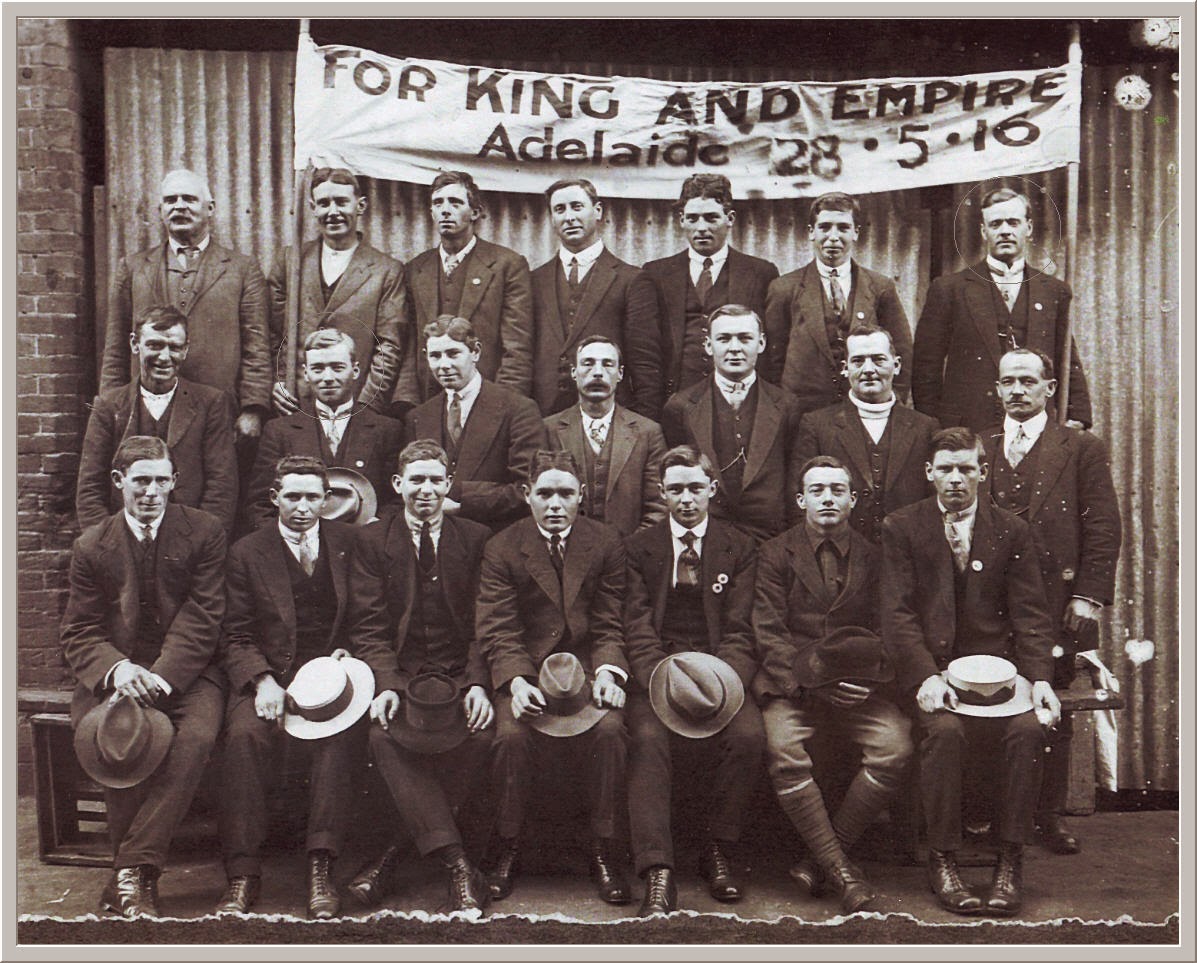
Melville and his brother Walter enlisted together on the 23rd May 1916 in Adelaide.

About 2 weeks after enlisting Melville was admitted to the camp hospital at Wayville with a fever.

On the 12th June he was transferred to Keswick Military Hospital, but his condition continued to deteriorate and on the 21st June he was admitted to the Infectious Diseases Hospital in North Adelaide, where he died on the 25th June 1916 from measles and bronchial pneumonia. Two other recruits died of meningitis on the same day.

Private Melville Fradd was buried at West Terrace Cemetery, Adelaide in Road 5, Row 5E Grave 52.

Because he died before the A.I.F. section was established, Melville's grave is in the general section of the cemetery. His family erected a headstone which had deteriorated with time. A small plaque with Melville’s military details has been placed at the foot of the grave.

His mother Hannah received a pension of 20 shillings a fortnight from the 26th June 1916.


"He left his home in health and strength

To answer his country’s call;

He gave his life, he gave his best

For you for me for all;

On Australia’s Roll Of Honour

You'll find our dear boy's name"


Memorian notice for Melville Fradd placed by his parents

The Chronicle 30 June 1917


Melville is commemorated on the:

1.    Australian War Memorial, Canberra, panel 186

2.    South Australian National War Memorial, Adelaide

3.    Honour Board in the Laura Civic Centre


There is some mystery as to the criteria used to select whose names would be commemorated on the Laura War Memorial. His name was not included presumably because he did not serve overseas. It is worth noting that the nearby Caltowie community chose to include on their memorial, a man who also died while training in Adelaide.

Honouring Soldiers

Beetaloo Valley, August 1st

Last night nearly all the residents of the neighbourhood assembled at the house of Mr. Fradd to bid farewell to Private Walter Fradd. Another of Mr. Fradds sons that joined the colours with Walter, recently died in camp (Melville)

Speeches were made by Messer’s A. Jacobi, P. Curtin and J.Murphy and the guest presented with a wristlet watch and trench candlestick. The visitors also requested the parents to accept a beautiful wreath to be placed upon the grave of their late son.
The Advertiser, 04 August 1916

The Nominal Roll listed Walter in the 10th Infantry Battalion, 20th Reinforcements when he sailed aboard HMAT Anchises from Adelaide on 28 August 1916 to go and fight in The Great War.

From Australia, his trip took a little under a month arriving at Plymouth, England before transferring to Folkestone; also in England, on the 11th of November 1916 where he stayed for close to 2 months before shipping out to France and the Western front.

 Walter was severely wounded with a gunshot wound/s to the abdomen; his record mentions that he also received wounds to the mouth and shoulder at the same time. This was possibly from machinegun fire that strafed the fields to hinder Allied advance as the Germans began their planned retreat.
Walter lay out in the battlefield for a long time and apparently there were badly wounded people all around him many of whom were screaming from pain. He found the noise almost unbearable and when the stretcher bearers came, he urged them to take those people first just so the noise would stop.

When Walter was finally taken back to the first aid post someone moved down the ranks of the wounded assessing their condition and attaching some sort of marker (I’m not sure what - a piece of paper or coloured cloth perhaps) which gave guidance as to their chances of survival. Walter was apparently "tagged" as "won't live until morning" and as a result wasn't given any treatment.

Obviously when he was still alive in the morning treatment was begun!

Wallis, a mate from nearby Laura, South Australia went to see him in the clearing station and stated that Walter was laying on one stretcher and his insides were laying on the stretcher next to him.

Walter was evacuated aboard the hospital ship HMHS Gloucester Castle.Incidentally, this ship was torpedoed by the German U-boat UB-32 off the Isle of Wight a few weeks later on 31 March 1917.
Surely a lucky man, he survived not only the assault on Malt Trench but also avoided this sinking to eventually return to Australia in late August 1917.


Melville [left ] Walter  [ right ] – circled

For King And Empire… Lest We Forget


Tuesday, 13 December 2016

The Shipwrights


…A shipwright is a ships carpenter who helps build, launch and repair wooden vessels. A professionally trained shipwright, however, can work with anything from small boats to large naval vessels.

In the 1800’s a shipwright would have crafted a bow, hull, keel, masts, and the ribs of the ship or boat by using tools such as an adze and a draw-knife. Fitting wood decking, cutting & bevelling shores for dry docking of ships was also part of the trade. They were very proud and specific about their craft. At sea they were responsible for ship stability including the securing of cargo and for loading and accounting of freshwater as well as fire-fighting and damage control. Generally a very busy man even on modern ships and I would guess extremely busy in the days of sail.
At that time the fishing industry was at its height, when pilchards were landed and cured here, and cured fish of many types, as well as wheat, barley, oats, cheese and minerals were being exported. A considerable variety of goods was also imported from Ireland, France, Wales, Scandinavia and Russia. Shipments of copper ore were made to Bristol and slates were also exported, many of them from the nearby Camel quarry.
Padstow in the 1860s was also a busy port for passengers emigrating to Canada, in particular to Quebec, which gave Padstow shipbuilders access to Canadian timber, some of which was carried in the same ships on return journeys.
By the 19th century a number of ship-building yards had been established along the banks and in the shallow creeks of the Camel river at Padstow.
Fig. 2 The Pub in Padstow

There were 5 ship-building companies in Padstow called John Cowl and Sons, Rawl, Stribley, Tredwen  and Willmett. It is not known which yard that William was employed but it could possibly have been with the the Rawl or Willment yard.
The Willmett’s shipbuilding activities ended in Padstow in 1867 with the building of the schooner Amanda and William was listed 4 years later, as living in Cardiff, Wales in the 1871 census. In all, the Willmetts built fifteen ships at Padstow between 1861 and 1867.
William married Margaret Huskisson Stubington of Soberton, Hampshire, England which could suggest that William went to the Portsmouth Dockyard looking for employment prior to Wales.
William and Margaret raised 9 children, the first was born in Hampshire and the next eight were all born in Cardiff, Wales.
In Cardiff in1839, the Bute West Dock was built followed by East dock in 1855. The Roath Basin was dug in1874 followed by Roath Dock in 1887. This is probably where William worked as he was living in Roath in 1881. In this modern dockyard, each shipwright undertook work anywhere in workshops, aboard ships or in any associated buildings, structures, or equipment.
Their work included manufacture, erection, repairs & alteration to ships structures, ships plating and welding. Installation of ventilation trunking systems, thermal & sound insulation, and the fitting out of compartments including the laying of deck coverings.


Fig. 3 Padstow Harbour circa 1900
Samuel Fradd was born on 03 Apr 1853 in Padstow, Cornwall, England (Christened 17 May 1853). He lived in Padstow, Cornwall, England between 1861 and 1871. He lived in 15 Dumbarton Street, Portsea, Hampshire, England in 1881 (He was living with his sister and brother-in-law Mary and David Hart). He married Mary Jane Thorne on 02 Apr 1882 where they lived in Portsea, Hampshire, England up until 1901 when they moved to Portsmouth, Hampshire, England in 1901. He died in 1931 having sired some craftsman. 

Fig, 4 1901 Census Record


THE SHIPWRIGHTS
Samuel Fradd, Shipwright, Hampshire, Portsmouth 1891; Alfred Fradd Naval Shipwright, Hampshire, Portsmouth 1891; Gary Kenneth Fradd, Shipwright, Sydney,1983


Sunday, 11 December 2016

Edith Maude Fradd 1893


Fig. 1 Edith Maude Fradd
 

Edith Maude Hill was born on 01 Jun 1895 in Lower Broughton, South Australia, Australia to Herbert Abraham Hill and Ada Edith Mathews.

She married Herbert William Fradd on 14 Oct 1914 in Residence of Herbert Abraham Hill, Laura District, Clare and raised a family of 8 children, 5 in Laura and 3 in Crystal Brook. Herbert was listed as living on West Terrace in Laura, South Australia with the occupation of a Farm Labourer and he was also a shearer.


Fig 2. Page from Longfellows Birthday Book


Edith and Herbert raised 8 children; four boys and 4 girls. Herbert married Edith Maud Hill of Clare on the 14th October in 1914;  they lived in an old stone house on a big block in Stanley Street, Crystal Brook and prior to that, lived in Laura, South Australia. Edith went by the name of Edie and is the maternal grandmother of Gary Kenneth Fradd.


Apparently she called all of her sons by the nickname "Joe" and all of her daughters by the nickname of "Fan". This was an oddity that perplexed her daughter in law Hilda Joy who remarked to me that both Herbert William and Edie would use the "Joe" and "Fan" terminology and yet each still seem to understand which individual they were talking about.

Editors note: This must have worked on Mum because she would quite often call me Joe as would Dad.
Edith's husband Herbert William Fradd died on the 19th March 1955; over 12 months before his grandson Gary Kenneth was born.


Fig.3 Surprise Birthday Guest List

J Parker (Hilda Joy Parker) was present above at a surprise birthday party. She married Edith's youngest son Kenneth Maxwell Fradd one year later; father of Edith and Herbert's grandson Gary. Edith Maud died on 17 Jan 1966 in Crystal Brook, South Australia, Australia when he was 12 years old. He remembered her moving into a house off of Gadd Avenue and weekly visits to the Fradds in Lyons Street Crystal Brook.


Saturday, 10 December 2016

Richard Fradd 1878


Richard Fradd was born about 1878 in St Mawgan in Pydar, Cornwall, England.  Richard was born to Josiah and Grace Williams; and was one of 9 siblings. He is the 2nd cousin 3 times removed of Gary Kenneth Fradd. St Mawgan in Pydar lies in and about the beautiful Vale of Lanherne.
Settlements dating from the Bronze Age and the Iron Age have been excavated in various parts of the parish. The village of St Mawgan can probably be said to date from the arrival, in the 6th Century, of the Welsh missionary, Meugan or Mawgan at what is now Mawgan Porth.

Fig 1. Richard Fradd circa 1900

Census records show that Richard was aged 23 and employed as a masons labourer in Cornwall in1901, and then as a miner in 1903 in Cape town, South Africa. 
His brother Francis David a Copper Miner also left Southampton for the Cape in 1902.
I suspect they were both caught up in the gold rush. 
Richard travelled all over the world as a miner in the early 1900's.
The steamship SS Galeka delivered him and many others from Southampton to the Cape in 1903. Of all of the trades, they were predominantly miners.

Fig.2 Taken in South Africa -Back Row, third from left


She served on the South Africa route until the First World War when she was used by the UK as a troop transport, carrying troops of the Australian and New Zealand Army Corps to the Gallipoli Campaign. Galeka was then refitted as a hospital ship with accommodation for 366 wounded passengers. On 28 October 1916 she hit a mine laid by the German U-boat UC-26.The ship was the last vessel to enter service before the merge between the Union and Castle shipping lines.


Fig.3 Attestation Paper


Richards Casualty Form - Active Service show that he attested oath aged 38 years and 1 month on the 25th February 1916 where he was mobilized to the Army Reserve, into
the11th Battalion, 3 months later onto the 53rd (Young Soldier) Battalion. Up to 27 October 1917, this was known as 95th Young Soldier Battalion and had no regimental affiliation. Before that it had been 11th (Reserve) Battalion of the Duke of Cornwall’s Light Infantry.
A basic recruit training unit based at Chisledon, it was part of 22nd Reserve Brigade. On 31 October 1917 when that Brigade was broken up it went to 8th Reserve Brigade at Larkhill.

In 1916 when conscription was first introduced for the British Army, the existing regimental system could not cope with the large influx of recruits. By January 1916, when conscription was introduced, 2.6 million men had already volunteered for service, a further 2.3 million were conscripted before the end of the war; by the end of 1918, the army had reached its peak strength of four million men. To train the recruits from 1916 onwards twenty-six reserve brigades were raised, with an official complement of over 208,500 soldiers.


Fig.4 Richard Fradd Circa 1916

After the war, Richard settled back in Trevarrian, Cornwall before he died on 29 Sep 1934 in Mawgan Porth, St Mawgan-In-Pydar, leaving effects and £710 to his wife Alice.

They have 1 sibling a daughter; Agnes Margaret shown listed in the 1939 Census.

1939 Census, Fradd Household

Croydon C.B., Surrey, England 

Agnes M Murray (Fradd) 1923

Alice Fradd and 1 more person are on this record.


Saturday, 19 April 2014

Constance Dalmorton Fradd [nee Sanders] 1890


Constance Dalmorton Stuart-Sanders was born on the 22nd July 1890 in North Adelaide, South Australia and trained as a nurse at the Royal Adelaide Hospital for 3 years. She lived at American Beach, Kangaroo Island, South Australia when she enlisted as a Staff Nurse on the 20th April 1917.

When war broke out in 1914, the Australian Government raised the first Australian Imperial Force for overseas service. The nurses to staff the medical units, which formed an integral part of the AIF, were recruited from the Australian Army Nursing Service Reserve and from the civil nursing profession.

More than 3,000 Australian civilian nurses volunteered for active service. While enabling direct participation in the war effort, nursing also provided opportunities for independence and travel, sometimes with the hope of being closer to loved ones serving overseas.

Nurses served wherever Australian troops were sent, and numerous other countries besides these. Some also served in British hospitals in various theatres of war including Burma, India, The Persian Gulf, Egypt, Greece, Italy, France, Belgium and England.

The record of service for these sisters is a brilliant one, and one which set a very high standard for all who were to follow.

The workloads and consequent stress these nurses endured, during the First World War, included  a 1,000 bed hospital, in Cairo, completely under tentage, without any floor covering that was staffed by 1 Matron, 15 Sisters and 30 Staff Nurses with male medical orderlies from the Australian Army Medical Corps. In 1917, the hospital had to be extended to 2,000 beds during a “heavy rush.”


Fig1: Depicts tents at the 3rd Australian General Hospital, Abbeville, north-western France (near Amiens).


Compare this to the Royal Melbourne Hospital in 1990... 700 beds and a staff of 670 nurses, excluding administration and education.

Acting under such adverse conditions, these ladies proved themselves to be of awesome dedication, courage and spirit, and truly professional.

 It was said …'Your qualifications as a nurse must include - Gentleness, Cleanliness, Truthfulness, Observation, Order, Courage and Coolness, Tact'

 “I pledge myself loyally to serve my King and Country and to maintain the honour and efficiency of the Australian Army Nursing Service. I will do all in my power to alleviate the suffering of the sick and wounded, sparing no effort to bring them comfort of body and peace of mind. I will work in unity and comradeship with my fellow nurses. I will be ready to give assistance to those in need of my help, and will abstain from any action which may bring sorrow and suffering to others. At all times I will endeavour to uphold the highest traditions of Womanhood and of the Profession of which I am Part.”

Constance embarked with the unit Nurses (July 1915 - Nov 19-18) from Adelaide, South Australia on board a royal mail steamer RMS Khiva on the 31st of May 1917 and served in Bombay, India where conditions were awful. She was probably based at Deolali which was a British Army camp 150 miles north-east of Bombay.

Between 1916 and 1919 more than 500 AANS nurses served in British hospitals in India, where their patients included hundreds of Turkish prisoners of war and wounded British troops. The nurses found the tropical monsoonal climate debilitating.

“English nurses could not stand the heat and cholera … that is why they have sent Australians.” Sister Jessie Tomlins

Constance married Leonard Collins William Fradd on the 10th October 1918 in St Thomas Cathedral, Bombay, India. Captain Leonard Fradd, 6th South Lancashire Regiment, was attached to the 4th Reforms Battalion, in Bangalore India. Constance resigned on the 12th October 1918 due to marriage.

For the next 45 years Constance is found in shipping records travelling by sea to London, England and Durban, South Africa right up until aged 64 where she was recorded as having lived in Kadina, South Australia. It is not known whether any children were issued from this marriage.
Constance died on the 26th November 1972 aged 82 years and is buried in the North Road Anglican Cemetery, St Kilda, Melbourne, Victoria.

Sunday, 9 March 2014

The Newton Abbot Workhouse


Thomas Fradd was born to (as yet) unknown parents on September 1st 1869 at Tormoham, a parish in Newton-Abbot district, Devon, England. He was named as a 15 year old inmate in the Newton Abbot Workhouse during the 1871 Census.

A Workhouse was a place where people who were unable to support themselves could go to live and work. Towns rarely subscribed to the idea of issued relief. It was much easier to pack the poor into a Workhouse and make them suffer unpleasant conditions to ensure that these people avoided being such charges to the ratepayers.

Because of the complete loss of dignity the Workhouse became the ultimate shame for the poor.

The 1834 Poor Law Act required changes and incorporation where villages were required to group into "Unions" for assistance of the poor. The "Union House", serving a group of parishes, was controlled by a Board of Guardians, hardly familiar with the poor they were supposed to help, and more concerned with the cost to the rates.

To some extent the system became self-perpetuating. On the old system of "out-relief" the poor received help and had some chance of getting back on their own feet again. In the workhouse they had nothing; they worked for a pittance and thus had little chance of finding decent work and re-establishment in the community.

The original Newton Abbot ‘poorhouse’ was based in East Street, and the cellar of the Devon Arms was used as the oakum picking room—where paupers were assigned the unpleasant job of untwisting old rope to provide oakum, used to seal the seams of wooden boats.


The Workhouse, East Street, Newton Abbot - c 1880


In 1839, a new workhouse was built in East Street and was used to house paupers from the surrounding areas. It was proposed to accommodate 350 inmates from 39 constituent parishes which surrounded Newton Abbot.

Records from the poor law unions, which were created from this time forward, include the following:

Guardianship

Creed Registers

Rate books

Workhouse Lists of Inmates

Register of Apprentices

Register of Births

Register of Deaths

Vestry Rate Books

Admission and Discharge Registers

Board of Guardians' Records

 
A 'bastardy clause' in the 1834 Poor Law Amendment Act had made all illegitimate children the sole responsibility of their mothers until they were 16 years old.

The putative father therefore became free of any legal responsibility for his illegitimate offspring.

Unmarried pregnant women were often disowned by their families and the workhouse was the only place they could go during and after the birth of their child.

The highly controversial measure in the 1834 Act was overturned in a subsequent Act in 1844, which enabled an unmarried mother to apply for an affiliation order against the father for maintenance, even if she was not in receipt of poor relief.

However unmarried mothers from poor backgrounds still entered the workhouse to have their babies.

Pregnant women who were ill, infirm, very poor or deserted by their husbands, and who became dependent on poor relief, were also forced into the workhouse to give birth.

In 1878, the Newton Abbot workhouse had room for about 400 inmates. The wards, yards etc. occupied 2 acres and there were gardens adjoining.

By 1890 there were reports of cruel treatment. In 1894, the workhouse was the focus of an inquiry by the Local Government Board.

It was claimed that a strait-jacket, called a 'jumper' was in regular use, and that elderly paupers had been placed in it naked, and then tied to beds. This had led, it was alleged, to the deaths of some inmates.

Witnesses described that the wards were filthy, and the inmates infested with vermin. A nurse testified that she had found a female inmate dying, her hair had been cut off, and her toe-nails were like claws. Another paralysed inmate had injured herself with her uncut finger-nails.

Another nurse said she had been given sole charge of about 150 sick paupers. The beds were filthy and sick children were under the care of two partially blind women. One child had been tied to a bed with string to prevent it from running about as it had no shoes and stockings. Eleven children had four nightgowns between them. Neither brushes nor combs were provided and their food was kept in the lavatories. Another witness said she saw two men tied to the same bed.

A woman with, what we would now call, learning disabilities was observed in the workhouse yard crouched in a corner with a bruised face. A shed had been built for her in the yard, but the boys threw stones and snowballs at her. Her tormentors included the master's son. Fighting amongst the inmates (who were described as 'idiots) was common, as was 'immorality' amongst them.

The matron for almost thirty years, Ann Mance, was accused of neglecting her duties, having visited the sick ward only five times in three months. She was dismissed, and died from a heart condition a few weeks later.

The workhouse era ended, officially at least, on 1st April 1930; the Boards of Guardians were abolished and their responsibilities passed to local authorities.

Newton Abbot Workhouse became the Newton Abbot Public Assistance Institution; more of a hospital for the sick, infirm and aged poor. A new infirmary was built, and during the wars some of the buildings were used as a military hospital. By 1950, the workhouse buildings were incorporated into part of Newton Abbot Hospital.

Thomas went on to marry Mary Unknown in about 1893 and raised 8 children in Hennock, and Torquay in Devon, and then in Darwen, Lancashire (1911 Census).


Monday, 6 May 2013

Raymond John Fradd 1909

Raymond John Fradd was born on the 9th of April 1909  in Broken Hill, New South Wales to Francis Frank and Stella A Fradd [nee Unknown]. It is suspected that he is a half-brother to Chester Douglas Fradd. Both boys were committed to the Mittagong Farm Home For Boys on the 23rd of March 1919.Raymond or "Jack" as he was known was 9 years old and Chester was 12.

N.S.W. State Records.

On the 5th of June 1906 in accordance with the provisions of the Neglected Children and Juvenile Offenders Act 1905,  the Farm Home for Boys at Mittagong was proclaimed an Industrial School. Mittagong Farm Home For Boys was a 500-acre property opened on the 17th of October 1906 as a government-run Probationary Training Home for boys aged 8 to 17 who were convicted in the Children's Courts of less serious offences including truanting, being uncontrollable, being neglected and wandering, breaching probation, stealing, and breaking and entering. 81 boys were admitted in the first six months.

The Home was situated on land already used as cottage style accommodation for state children who were sick or invalid. No-one who ended up at the Mittagong Farm Home, ended up there by choice. It was a place where children were sent to live because of different circumstances.
Over the years, the homes accommodated children from various walks of life, including orphans, state wards, mentally challenged and ill children. Some were taken away from their parents for their own wellbeing while others were sent to the homes because they were truants or were in trouble with the law. Some came from broken families where the father had left and the mother was trying to raise five or six children on her own.


Mittagong Boys Home Cottage c 1910

There was no dole or child endowment and no money from the fathers - so mothers would send some or all of their children to the homes, so that she could go out to make a living; knowing that her children would be guaranteed food, clothing and shelter- which was something many struggling mothers could not do for their children if they didn’t let them go. Displaced children were sent from orphanages in Sydney to live in private cottage homes in the Mittagong area from about 1881.The struggle for individual families to feed the additional children in their homes saw the State Government of the time lease a portion of land from about 1885 with the intention was to grow food on the property which already had several buildings on it and an orchard. More buildings were established and homeless men from the city were sent down to live there and work the land. They produced enough food to support children in homes both in Sydney and Mittagong.

The government decided to buy the site in 1907 with children accommodated in farm homes on the property and in cottage homes in the Mittagong community.The boys were in the charge of an attendant and matron (usually a married couple). Boys under 14 (and older boys with a low standard of education) attended nearby lower Mittagong Public School. The older boys, under the supervision of the attendant worked on the Farm lands adjacent to the Home cultivating fruit and vegetables, dairying and raising poultry. Most boys stayed at Mittagong for short periods. The average stay at the institution was four to five months. Boys who were responsive to the program at Mittagong were released on probation to a relative, boarded-out or apprenticed out,  and those who showed no evidence of reform were sent to the Farm Home for Boys at Gosford.  In July 1911, 34 boys were transferred to the Home from the Nautical School-Ship the "Sobraon" which ceased operations. The Mittagong Home was divided into cottages with 20 - 30 boys to each cottage. Turner Cottage was set aside for truants. In 1944 Anglewood Special School, Burradoo was established to assist with housing the increasing number of male truants.

After May 1946, Anglewood was able to accommodate all truant boys. Special educational programs were provided for intellectually disabled residents.From 1946 the Institution was sometimes called the Mittagong Training School for Boys; and from 1947 the latter name was used uniformly. On 23 August 1974 a new cottage for younger boys was opened, enabling a maximum population of 180 boys. The Mittagong Training School for Boys was gradually phased out as a Home for Delinquent Boys. On 30 June 1976 only 33 boys were in residence. In August 1976 the Institution ceased to operate as a Training Centre and the remaining boys were transferred to Ormond House, Thornleigh. Subsequently Mittagong Training School for Boys was established as a home for dependent children and became part of the newly named centre, Renwick.
Bibliography: http://www.records.nsw.gov.au/
Jack married Beryl Constance Lawrence on the 23rd of January 1932 in West Maitland, New South Wales, Australia.  They had three children. He died on the 07th of August 1971 in Parramatta, New South Wales, Australia. 


Edwin Horace Fradd 1856

Edwin Horace Fradd was born in 1856 in Durban, Natal, South Africa; the only child of Joseph Ede Fradd (a Woolen Draper) and Susan nee Norwa...